Categories
Fat Free fibre Gluten-free Indian Low GI Millets Protein Vegetarian Whole Grains

Millet, a true Supergrain

Come January each year, every one makes some kind of resolution and more often than not, change in food habits is a part of those resolutions.

Every year you see trends popping up on the food scene, Cauliflower rice, Zucchini noodles, Kombucha and so on, some stay and some vanish with time. However there are certain foods that have stood the test of time, not just for a few years but thousands of years. One such group of food is Millets. Millets have been grown and consumed for over 10,000 years and India is one of the largest producers of Millets

Although Millets are generally used and looked at as a cereal, they are in fact from the grasses family. In this post we will talk, discuss, fall in love yet again with some of the millets commonly available.

Why Millets?

Good for environment & the farmers

  • Needs 1/15 th Water to grow 1 kg of Millet compared to Rice or Wheat
  • Millet crop can withstand higher temp up to 115F vs rice/wheat at 99 F
  • Millets can be grown pretty much in any type of soil, even saline soil
  • Millet grains don”t go bad easily, can be eaten even after 10-12 years reducing food wastage

Packed with Nutrition

  • High levels of calcium compared to rice & wheat
  • Packed with Amino acids, Iron and other nutrients like phosphorus
  • High levels of biological value protein
  • Gluten-free
  • Alkaline
  • High fibre
  • Low Glycemic Index

Types of Millets

Jowar or Sorghum

Growing up in Solapur Jowar Bhakri (Sorghum flat bread) was something we ate as much if not more than the wheat roti or rice. Its still my most favorite bread in the world. I have a video on how to make this bread.

Sorghum is a super grain that has low glycemic index, full of fibre making it a great choice for a healthy diet. I not only include it as a bread but also make Granola and also a savory with it. Jowar flour can be quickly made into ‘Ambil’ a savory breakfast pudding from Maharshtra.

Bajra or Pearl Millet

Although we enjoyed Jowar Bhakri all year long, come winters we would switch to Bajri Bhakri. It is believed that Bajra is ‘Hot’ in nature and hence perfect for the winter months. Its often eaten with Jaggery which also is believed to have ‘Hot’ properties.

Bajra or Pearl millet is one of the most commonly used millets in India. Bajra Khichadi, a risotto like dish made with the millet and some lentils is a perfectly nutritious and comforting dish found in every household in Western India, often served with ghee, raita, pickle and salad, its a complete meal.

I love sprouting the Bajra to make salads, and even make sprouted millet flour for my pancakes.

Finger Millet

Popularly known as Ragi or Nachni in India, this mustard seed like grain is a power house.

Baryard Millet

Its a type of Pearl millet but smaller in size

Little Millet

Commonly known as Sama ke chawal( in Hindi) or Varai in Marathi, this millet is often consumed during fasting for festivals like Navratri. It can be used as Sooji or cream of wheat

There are many other millets that are used in the traditional Indian cooking. Earthy in taste and with a great texture, they are a versatile option and great alternative to the usual wheat, rice.

You can easily modify many recipes to incorporate Millets easily.

What does Ayurveda say about millets ?

From an Ayurvedic point of view, millet is considered to be Sweet, Heating, Dry and Light. This makes it a rather special grain because it has the satisfying, nourishing effect of the Sweet taste but at the same time is light, easy to digest. Due to its light, heating and drying effect, millet is used as ‘food medicine’ in the treatment of high Ama, dull Agni, diabetes, excess weight, oedema and other excess Kapha (mucous/fluid) conditions. If eaten in excess it may aggravate Vata or Pitta but if soaked and then cooked with a little oil and some cooling spices (like fennel and coriander), it is can be transformed into a relatively tridoshic grain.

Millet recipes

I worked with 24 Mantra Organic, a company from India which focuses on bringing such products to the market and with complete transparency. I created four recipes using various kinds of Millets. Here are the links

Ragi Parfait

https://www.facebook.com/chefex.in/videos/341020713185540

Mexican Salad rolls

https://www.facebook.com/chefex.in/videos/2156584874652357

Foxtail millet risotto

https://www.facebook.com/chefex.in/videos/1575409352589338

Categories
Curry Daal Gluten-free Healthy foods Indian Lentils Low carb Maharashtrian Protein salad Vegan Vegetarian

Pendpala- a dry masoor daal curry

Daal or lentils are an integral part of the Indian cuisine. Its used in many forms, with skin, without skin, powdered, roasted, raw and so much more. In parts of India where the water is scarce, not enough fresh vegetables, you will see a predominant part of region’s cuisine. If you visit Rajasthan, the western state of India, you will see so many dishes that made with Chick pea flour, like Gatte ki kadhi, Kachori etc.

Hearty Solapuri meal

Solapur, the town I come from is situated in the middle of state Maharashtra. There are no rivers or water bodies near Solapur and the summers are brutal. All of this means that the cuisine relies on shelf stable ingredients more than the fresh vegetables or fish. You will see use of Jowar and Bajra more than the wheat and rice. Jowar and Bajra and drought tolerant and need much less water than growing wheat or rice.

Millets like Jowar or Sorghum and Bajra or pearl Millet are excellent source of nutrients. They provide lots of essential nutrients not only to the human beings but it’s also gentle on the soil

Typically farmer, or those who do lot of physical labor, and come from neighboring villages for work, often pack a hearty lunch of Jowar Bhakri, peanut chutney and some dry subji. The subji is dry which prevents it from getting soiled in the hot weather of solapur. Often times it has lentils or chickpea flour

One such preparation is Pendpala. I don’t know how the name came about but I can guarantee you, it’s plain delicious. Full of protein, it’s is a a great compliment to the bhakri and completes the meal

I love that all of the ingredients needed to make this are shelf stable and easily available.

What makes it absolutely delicious is the Kala Tikhat, a special spice mix from Solapur. It’s a combination of many whole spices, along with onion and garlic. I will share that recipe soon. It’s made a few times a year and can be used in many recipes.

I learnt this from Anusaya. Anusaya is help at home but she is much more than that. She is family. She has been coming to our house for the last 45 years. I have rarely seen even family members as loyal as she is 🙂

Kala Tikhat

Some people call it Daal Kanda, which translates to Lentil Onion, and some also make it with toor daal. I make the Pendpala with Masoor daal and serve it with sorghum bhakri, peanut chutney, Green Tomato chutney and raw onion. A complete, balanced, wholesome, protein packed, gluten-free vegan meal 🙂

Masoor Pendpala Solapur style

Spicy, delicious lip smacking daal recipe, easy to make

Course Appetizer, Side Dish
Cuisine Indian, Maharashtrian, vegan, vegetarian
Keyword daal, lentils, vegan, vegetarian

Ingredients

  • 1 Cup Split masoor daal
  • 1 Onion Chopped
  • 2 Garlic cloves
  • 2 Tbsp Oil
  • 1 Tsp Turmeric Powder
  • 1 Tsp Salt
  • 4 Tbsp Roasted peanut powder
  • 1 Tbsp Chopped cilantro
  • 1 Tbsp Kala Tikhat
  • 1/2 Tsp Red chili powder optional

Instructions

Prep

  1. Soak the daal for 20-30 mins

  2. Drain the water

Cook

  1. Heat the oil in a wok. Add turmeric, and chopped onion and garlic.

  2. Cook the onions and garlic till soft, ensure that its not too burnt

  3. Add the drained daal, salt and stir to mix

  4. Cover and cook till the daal is soft on low-medium flame . We dont want it to be mushy. It should be cooked but hold its shape. It takes about 8-10 mins

  5. Add kala tikhat and red chili to taste

  6. Add peanut powder , cilantro and mix well

  7. Serve with Bhakri

Categories
fibre Gluten-free Healthy foods Low GI Protein Vegetarian

Rose Energy Ball

Its an age-old problem, what can be easy to make, tasty, delicious, something thats good for you and something that’s super packed with nutrients. Its tricky to find something that fits all the criteria, right?

So what if I tell you that the recipe I am about to share scores awesomely on all front. Its so easy to make that anyone can make it. There is no heat needed, so its kid safe too

Another great part about this recipe is that you can easily swap out ingredients and make it with what you have on hand and something that your family likes. If I don’t have dates, I add apricots or raisins. If I don’t have almonds, I use peanut butter. Sometimes its rose flavoring, sometime its cardamom, sometimes its cinnamon, even cumin, the possibilities are endless.

I love using Roses in my cooking, rose sherbat, rose petals and of course Rose Jam. So I have used that

I love how good this is for you. Full of protein, Omega -3, zinc, Magnesium, Iron, and the best part ,its tastes awesome.

I have made this for my friends, even friend’s Moms, they all want to place an order :). I love snacking on it before workout and as mid-night snacks. Instead of buying highly processed products, why not make these perfect workout snack at home

Here is the recipe.

Rose Energy Balls

Easy to make, healthy nutritious snack
Course Snack
Cuisine fusion
Keyword healthy, nutritious, protein packed, superfood, vegetarian
Prep Time 10 minutes
Cook Time 10 minutes
Servings 15 Balls

Ingredients

  • 1 1/2 Cups Rolled Oats
  • 1/2 Cup Dates
  • 1/3 Cup Dark chocolate chips
  • 1/4 Cup Chia seeds
  • 1/3 cup Dry unsweetened coconut
  • 1/2 Cup Nut butter
  • 2 Tsp Honey/ Agave/ Maple syrup/molasses
  • 2 Tbsp Whey powder optional
  • 1 Tbsp Rose syrup optional

Instructions

  1. Pulse the oats and dates in a food processor. Add rest of the ingredients and process till everything comes together
  2. Shape into balls and roll into either unsweetened cocoa / dry coconut/ rose petals
  3. Keep at room temperature for a week
Categories
Bihari Drinks & Coolers Fat Free fibre Gluten-free Low GI Protein Vegan Vegetarian Whole Grains

Sattu Ka Sharbat & Banaras

Growing up in Maharashtra, India I had not heard much about this ingredient. My mom used to ask us to eat ‘Saatu’ but it did not quite register as a special thing.

Fast forward many years and I remember my first visit to Varanasi, I fell in love with this place. I know people talk about the dirt and filth but all I could see was the peaceful ghats, a tremendous sense of devotion, and one becoming aware of one’s mortality and of course the food.

Every corner you turned there was some amazing delicacy to be devoured. We feasted on Jalebis, Kachoris, Lassis and so much more. I don’t know if its the water, air or the fact that many of these places have been there for generations, but each thing tasted amazing. I don’t remember having bad food in that town.

A lot of the food eaten was Satvik, which means there was no onion and garlic in the recipe, honestly I did not miss it.

I am a Chai addict and I must say some of the best chai I have had was in Varanasi, I think its the milk thats pure and fresh which makes all the difference. I loved roaming through the lanes and exploring because I feel ‘Banaras happens in the gallis’

I just loved how chilled out people were here, taking there own time to read a news paper, chat with a friend over a plate of kachori or even get a haircut, everything had a sense of calm. I went on a boat ride every morning that I was there, just the sound of water and the oars, some bells in the background and bliss.

Ghats have a lot going on, different ghats decorated in different styles. If you just observe, you get to learn a lot.


I will never get tired of this city, its fascinating on many levels. I feel that even meditating here was very powerful and peaceful.

On our way to the airport we stopped for a cup of chai, I mean everyone knows what kind of chai you get inside the airport 🙂 . On the same stall this man was making litti chokha, and man that was some delicious preparation. He was roasting them on open fire and the best part was that the litti was stuffed with some tasty mixture called Sattu.

That was my introduction to this magical ingredient called ‘Sattu’. This is powder of sorts made with roasted whole chana in most part, however there are some variations that add barley as well as Jowar/sorghum to it. Its commonly seen in the Northern India, mainly Bihar & UP as well as Pakistan and Nepal. Simple sounding however a true superfood, Sattu can be used in multiple applications. Often times savory and sweet drinks are made using Sattu, and in Bihar you would get to taste delicious sattu stuffed litti or even parantha. I must tell you that parantha turns out amazing. I will share the recipe some day soon.

Not only does it taste good and easy to make but its a power house of health benefits. Super high in protein, fibre, gluten-free, vegan and perfect for the summer and it cools down the body.

So when I came back from Varanasi and was talking about it my driver was very happy. He is from Varanasi and an ardent Sattu follower. When he heard that I liked it, he brought two homemade sattu flours for me along with a recipe for the sattu savory drink. I made it and loved it.

I make an effort to make traditional recipes and follow whats good for you in that season, if you like that idea then try out this recipe. Its super easy

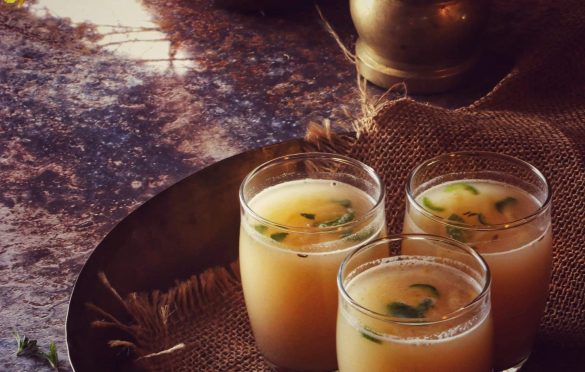
Sattu ka namkeen sharbat

Cooling  

Naturally gluten- free & vegan 

Low GI

Ingredients

  • 2 cups cold water
  • 2 tablespoon gram sattu
  • 1 1/2 tsp lemon juice like to taste
  • 1/4 T Spoon Sendha Namak
  • 1/2 tsp spoonful of cumin seeds
  • 1 tsp finely chopped mint
  • 1 tsp finely chopped cilantro
  • 3 tbsp peeled and grated Green Mango optional
  • 1/4 Tsp finely chopped green chillies optional
  • 1/4 tsp salt

Instructions

  1. Mix the sattu with a little bit of water, enure there are no lumps left

  2. Mix the rest of the ingredients along with the remaining water & stir

  3. Serve chilled 

Recipe Notes

You can also make a sweet version, mix a little bit of honey or Gud with water and sattu powder

Categories
Appetizer Bengali British European Protein Snack Vietnamese

East-er Eggs – Indian scotch eggs

You know how some ideas just keep brewing in your head but it takes forever for it to happen, but when it happens its even better than what you had imagined. Today’s recipe is one of those recipes.

It has two may be three recipes. They are different and yet complimentary and there is one thing that ties them together. I get excited and happy when that common thread works just so wonderfully.

Part One – London & Kolkata

I visited Kolkata with the family and absolutely loved the Bengali cuisine, especially the snacks and the sweets. The sweets made with fresh chenna that melt in your mouth are to die for. We were there when the most prized ‘Nolen Gur’ was in season and the sweet shops were showcasing various things made using this liquid gold, I fell in love with this Gud. The softest Rosogulla and sandesh made using this Gud were my favorite.

There are many snacks that are popular in Bengal. Different types of kachoris, Jhal Moori which is a snack made with puffed rice and the famous ‘chaap’ to name a few. The word ‘chaap’ possibly comes the english word Chop, but this one has no meat in it and instead is made from different vegetables, especially beets which gives it the classic red color. Its served with chutney like most Indian snacks.

I started making these chaap ever since then and everyone loves them.

I love traveling, within the country, internationally, alone, with a group, I just love to travel and more often than not, food is a critical component of my itinerary. So even when I was on a business trip to London, I made sure I visited the grocery store and local market and tried some of the specialities. One of the things I ate for the first time was Scotch Eggs. An egg wrapped up in minced meat and fried, then cut open and served with some mustard, its a popular pub food. I love eggs in any form so I had obviously liked these.

Today I decided to borrow on these two ideas for a a recipe I had in mind.

Beet Scotch Eggs

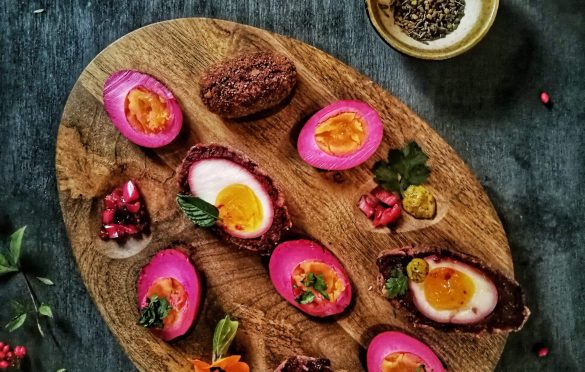
I took the beet mixture from the Bengali chaap, wrapped it around very soft boiled egg and deep fried it.. result.. delicious !!!!

Bangla Scotch Eggs with Kasundi

This recipe is inspired from two dishes I tasted and loved. 

Ingredients

  • 4 Beets Boiled and grated
  • 1 Potato Boiled and mashed
  • 1 Onion Finely chopped
  • 1/2 Tsp Garlic Paste
  • 1/2 Tsp Ginger Paste
  • 1/2 Tsp Garam Masala
  • 3/4 Tsp Roasted Jeera Powder
  • 1/2 Tsp Red Chili powder
  • 1 Green chili Finely chopped
  • 1 Tbsp Oil
  • Salt to taste
  • 4 Eggs

For coating

  • 1/3 Cup Maida/ All purpose flour
  • 1/3 Cup Water
  • 3/4 Cup Bread Crumbs

For Frying

  • Oil

Instructions

  1. Heat oil in a pan, add chopped onions and saute till soft

  2. Don’t let them caramelize 

  3. Add ginger and garlic paste and saute for a few secs

  4. Add the grated beet and saute till its almost dry 

  5. Now add cooked potato thats very well mashed

  6. Mix and saute well till the mixture is dry 

  7. Add salt, a pinch of sugar, garam masala, cumin powder and red chili powder

  8. Mix well 

  9. Add green chilies and turn the heat off 

  10. Set the mixture aside to cool 

Cooking the eggs

  1. Boil water in a sauce pan

  2. Once the water comes to a boil, slowly add all the eggs in the pot

  3. Cook for 4-5 mins with a rolling boil

  4. Drain the eggs  and run  under  cold water 

  5. Peel the eggs and set aside 

Batter for Frying

  1. Make slurry with the all purpose flour and water. The slury should be thin but thick enough the coat the egg. 

  2. Take the breadcrumbs in a bowl and season with some salt

Heat some oil in a deep pan on medium heat

Frying the eggs

  1. Take one eggs and fourth of the beet mixture. 

  2. Cover the egg completely with the beet mixture, making sure the coating is even and no gaps. Press the coating tightly, this ensures that the coating will not fall off while frying 

  3. Dip this beet covered egg in the slurry, ensure it oats the whole surface

  4. Roll it in the breadcrumbs 

  5. Fry the egg in the oil on medium heat till its crisp all around

  6. Let it cool and then cut it in half carefully. Since the egg is half boiled, the yolk would be soft and spreadable

  7. Serve with pickled onions and Kashundi 

Part two- California, Bengal

I love eggs and I love to eat them in any form, wait did I already say that? Anyway so I love making sandwiches as the weather gets warmer and one of my favorite is Banh Mi, a Vietnamese sandwich. Crusty white roll with even crunchier pickled vegetables, its a treat. I feel that pickles of all kind can perk up even a boring meal. Although now pickles are made in every part of the world, it is said that the process of pickling might have started in 2400 B.C in Mohenjo Daro. No matter who started making it, it sure is a favorite of many unless you are in a pickle ( get it 🙂 , sometimes I surprise myself with my play on words, hehe !)

So I wanted to pickle my eggs to make egg sandwich and then I got inspiration from the ‘Pennsylvania Dutch’ who add beets to their pickling process and I did just that. But I wanted to make it a little different and drew on my Indian spice box and one of favorite spice mix, Panch Phoran. Panch Phoran translates to Five Spices, it comes from Bengal, east India. Typically it has fenugreek, Cumin, Mustard seeds, Nigella seeds and Fennel. I love it because even though its simple, it delivers amazing flavor to any dish you add, daal, meat, fish or even pickle 🙂

These pickled eggs provide the much needed acidity to the fried Beet Scotch eggs.

Panch Phoran pickled eggs

Ingredients

  • 3 Tbsp Panch Phoran recipe on the blog
  • 1 1/2 Cup Red Wine Vingar
  • 4 Tbsp Thinly sliced shallot or red onions
  • 2 Beets Sliced or qurtered
  • 2 Tbsp Sugar
  • 1 Tbsp Salt
  • 4 Eggs Soft Boiled
  • 1 sprig Mint to serve
  • 1 Tbsp Kasundi to serve

Instructions

  1. Mix salt & sugar in the red wine vinegar and stir till dissolved 

  2. Gently pound the panch phoran and add to the vinegar

  3. Take a glass jar and add the eggs, sliced shallot and beets to it

  4. Pour over the vinegar mixture

  5. Close the lid and let it sit in the fridge for 2-3 days 

  6. When ready to serve, cut the eggs in half carefully

  7. Chop the pickled onions and beets finely

  8. Top the egg with the chopped onions and beets 

  9. Garnish with mint and kasundi 

Recipe Notes


Panch Phoran : Here is a simple recipe for your reference 

Don’t keep the eggs for longer than 3 days, you will not have a beautiful demarkation of red/pink and white

To soft boil the eggs, add eggs to boiling water and cook for 5 mins. Drain and run under cold water and peel 

You can also make deviled eggs with this. 


en_USEnglish