Categories
Fat Free fibre Gluten-free Indian Low GI Millets Protein Vegetarian Whole Grains

Millet, a true Supergrain

Come January each year, every one makes some kind of resolution and more often than not, change in food habits is a part of those resolutions.

Every year you see trends popping up on the food scene, Cauliflower rice, Zucchini noodles, Kombucha and so on, some stay and some vanish with time. However there are certain foods that have stood the test of time, not just for a few years but thousands of years. One such group of food is Millets. Millets have been grown and consumed for over 10,000 years and India is one of the largest producers of Millets

Although Millets are generally used and looked at as a cereal, they are in fact from the grasses family. In this post we will talk, discuss, fall in love yet again with some of the millets commonly available.

Why Millets?

Good for environment & the farmers

  • Needs 1/15 th Water to grow 1 kg of Millet compared to Rice or Wheat
  • Millet crop can withstand higher temp up to 115F vs rice/wheat at 99 F
  • Millets can be grown pretty much in any type of soil, even saline soil
  • Millet grains don”t go bad easily, can be eaten even after 10-12 years reducing food wastage

Packed with Nutrition

  • High levels of calcium compared to rice & wheat
  • Packed with Amino acids, Iron and other nutrients like phosphorus
  • High levels of biological value protein
  • Gluten-free
  • Alkaline
  • High fibre
  • Low Glycemic Index

Types of Millets

Jowar or Sorghum

Growing up in Solapur Jowar Bhakri (Sorghum flat bread) was something we ate as much if not more than the wheat roti or rice. Its still my most favorite bread in the world. I have a video on how to make this bread.

Sorghum is a super grain that has low glycemic index, full of fibre making it a great choice for a healthy diet. I not only include it as a bread but also make Granola and also a savory with it. Jowar flour can be quickly made into ‘Ambil’ a savory breakfast pudding from Maharshtra.

Bajra or Pearl Millet

Although we enjoyed Jowar Bhakri all year long, come winters we would switch to Bajri Bhakri. It is believed that Bajra is ‘Hot’ in nature and hence perfect for the winter months. Its often eaten with Jaggery which also is believed to have ‘Hot’ properties.

Bajra or Pearl millet is one of the most commonly used millets in India. Bajra Khichadi, a risotto like dish made with the millet and some lentils is a perfectly nutritious and comforting dish found in every household in Western India, often served with ghee, raita, pickle and salad, its a complete meal.

I love sprouting the Bajra to make salads, and even make sprouted millet flour for my pancakes.

Finger Millet

Popularly known as Ragi or Nachni in India, this mustard seed like grain is a power house.

Baryard Millet

Its a type of Pearl millet but smaller in size

Little Millet

Commonly known as Sama ke chawal( in Hindi) or Varai in Marathi, this millet is often consumed during fasting for festivals like Navratri. It can be used as Sooji or cream of wheat

There are many other millets that are used in the traditional Indian cooking. Earthy in taste and with a great texture, they are a versatile option and great alternative to the usual wheat, rice.

You can easily modify many recipes to incorporate Millets easily.

What does Ayurveda say about millets ?

From an Ayurvedic point of view, millet is considered to be Sweet, Heating, Dry and Light. This makes it a rather special grain because it has the satisfying, nourishing effect of the Sweet taste but at the same time is light, easy to digest. Due to its light, heating and drying effect, millet is used as ‘food medicine’ in the treatment of high Ama, dull Agni, diabetes, excess weight, oedema and other excess Kapha (mucous/fluid) conditions. If eaten in excess it may aggravate Vata or Pitta but if soaked and then cooked with a little oil and some cooling spices (like fennel and coriander), it is can be transformed into a relatively tridoshic grain.

Millet recipes

I worked with 24 Mantra Organic, a company from India which focuses on bringing such products to the market and with complete transparency. I created four recipes using various kinds of Millets. Here are the links

Ragi Parfait

https://www.facebook.com/chefex.in/videos/341020713185540

Mexican Salad rolls

https://www.facebook.com/chefex.in/videos/2156584874652357

Foxtail millet risotto
https://www.facebook.com/chefex.in/videos/1575409352589338

Categories
dessert Drinks & Coolers Fat Free Fusion Gluten-free Indian Italian Vegan Vegetarian

Kokum Granita

Summer is almost here  and I have all these amazing memories of different summer vacations I have taken.

I remember waking up to beautiful mornings with the birds were chirping, and scent of various flowers filled the air. One of the birds was called Tambat, which translates to Coppersmith. It makes a sound of a hammer beating down a sheet of copper, I guess that’s where it got its name from. After waking up we would wash up, I still remember those big copper earns filled with water.

My Mami a typical woman from Konkan, unadulterated love, simple life and always a smile on her face that’s how I remember her. She would make beautifully scented rice porridge  which would be served on a giant leaf of a Moochkund tree, which is also called ‘dinner plate’ tree. It was simply dressed with a touch of ghee and salt.

Muchkund Leaves

There were bounties of summer like Karvande, Jambhul, but best part about that vacation used to be mangoes, mangoes for breakfast ,Mangoes for lunch, mangoes for snack Mangoes for a drink, what more can one ask for. I still remember very vividly the room full of mango is layered beautifully on a bed of hay. My aunt would tell us to go look for the ones that are ripe and then the party started.

We would wander around in the village, on the paths paved with Chire, a red stone from that region, leading up to the temple. There was a small pond near the temple called Ban Ganga, we would explore around and head home when the stomach started growling.

Mami would have a drink ready for us, made from the Kokum or ratamba as its called in that region. Gorgeous garnet, ruby color, delicious taste and thirst and heat quenching, this used to the the perfect treat after a walk in the village.

Kokum Sherbat

Fast forward to 2018 when I went to Sicily with my family. I fell in love with Italy and would love to live there some day. We enjoyed some amazing foods and a few of the favorites originated in Italy. Cannoli, Arancini to name a few. One of those dishes is Granita, a refreshing icy treat that comes in all kinds of flavors. It so reminded me of the Barf Gola we get in India.

Gelato

The best part was that the granita is enjoyed at breakfast with brioche, dessert for breakfast, what more can one ask for.

So today’s recipe is my summers relived, Kokum granita showcases two of my favorites, konkan and Sicily.

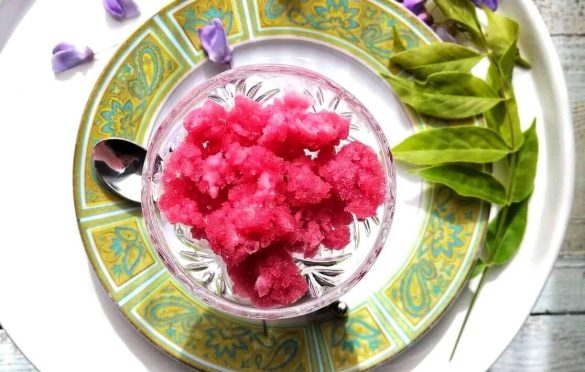
Kokum Granita

A refreshing summer dessert with tangy and sweet flavors

Servings 4

Ingredients

Ingredients

  • 3/4 cup Kokum Agal without sugar
  • 2 1/2 cups of water
  • 1 1/2 cup sugar
  • 1 tsp Cumin powder
  • 1/2 tsp salt

Instructions

Method

  1. Bring 1 cup of water and sugar to a boil. Keep stirring till sugar dissolves.
  2. Keep aside. Stir in the rest of the water. Taste and add more sugar if needed
  3. Add cumin powder and salt and stir.
  4. Put this mixture into a baking tray, keep it in fridge for 2-3 hours. The mixture will start freezing around the edges slowly. Take the tray out and scrape the frozen part with fork, and put it back in the freezer.
  5. Keep repeating till all of the mixture is frozen into fine ice.

Serve it in a bowl.

Recipe Notes

You can make this a couple of days ahead, just make sure to scrape it with a fork right before you serve

You can also serve it with cream or ice-cream 

You can serve it at breakfast with brioche 

Categories
Bihari Drinks & Coolers Fat Free fibre Gluten-free Low GI Protein Vegan Vegetarian Whole Grains

Sattu Ka Sharbat & Banaras

Growing up in Maharashtra, India I had not heard much about this ingredient. My mom used to ask us to eat ‘Saatu’ but it did not quite register as a special thing.

Fast forward many years and I remember my first visit to Varanasi, I fell in love with this place. I know people talk about the dirt and filth but all I could see was the peaceful ghats, a tremendous sense of devotion, and one becoming aware of one’s mortality and of course the food.

Every corner you turned there was some amazing delicacy to be devoured. We feasted on Jalebis, Kachoris, Lassis and so much more. I don’t know if its the water, air or the fact that many of these places have been there for generations, but each thing tasted amazing. I don’t remember having bad food in that town.

A lot of the food eaten was Satvik, which means there was no onion and garlic in the recipe, honestly I did not miss it.

I am a Chai addict and I must say some of the best chai I have had was in Varanasi, I think its the milk thats pure and fresh which makes all the difference. I loved roaming through the lanes and exploring because I feel ‘Banaras happens in the gallis’

I just loved how chilled out people were here, taking there own time to read a news paper, chat with a friend over a plate of kachori or even get a haircut, everything had a sense of calm. I went on a boat ride every morning that I was there, just the sound of water and the oars, some bells in the background and bliss.

Ghats have a lot going on, different ghats decorated in different styles. If you just observe, you get to learn a lot.


I will never get tired of this city, its fascinating on many levels. I feel that even meditating here was very powerful and peaceful.

On our way to the airport we stopped for a cup of chai, I mean everyone knows what kind of chai you get inside the airport 🙂 . On the same stall this man was making litti chokha, and man that was some delicious preparation. He was roasting them on open fire and the best part was that the litti was stuffed with some tasty mixture called Sattu.

That was my introduction to this magical ingredient called ‘Sattu’. This is powder of sorts made with roasted whole chana in most part, however there are some variations that add barley as well as Jowar/sorghum to it. Its commonly seen in the Northern India, mainly Bihar & UP as well as Pakistan and Nepal. Simple sounding however a true superfood, Sattu can be used in multiple applications. Often times savory and sweet drinks are made using Sattu, and in Bihar you would get to taste delicious sattu stuffed litti or even parantha. I must tell you that parantha turns out amazing. I will share the recipe some day soon.

Not only does it taste good and easy to make but its a power house of health benefits. Super high in protein, fibre, gluten-free, vegan and perfect for the summer and it cools down the body.

So when I came back from Varanasi and was talking about it my driver was very happy. He is from Varanasi and an ardent Sattu follower. When he heard that I liked it, he brought two homemade sattu flours for me along with a recipe for the sattu savory drink. I made it and loved it.

I make an effort to make traditional recipes and follow whats good for you in that season, if you like that idea then try out this recipe. Its super easy

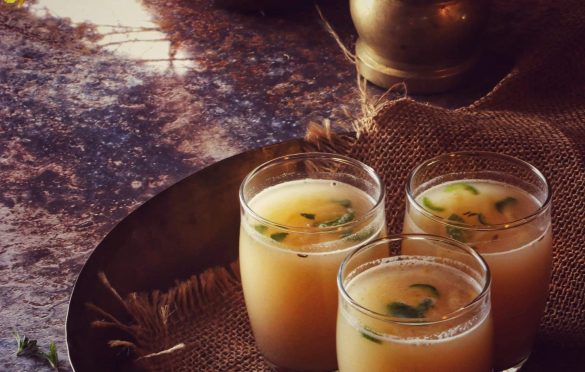
Sattu ka namkeen sharbat

Cooling  

Naturally gluten- free & vegan 

Low GI

Ingredients

  • 2 cups cold water
  • 2 tablespoon gram sattu
  • 1 1/2 tsp lemon juice like to taste
  • 1/4 T Spoon Sendha Namak
  • 1/2 tsp spoonful of cumin seeds
  • 1 tsp finely chopped mint
  • 1 tsp finely chopped cilantro
  • 3 tbsp peeled and grated Green Mango optional
  • 1/4 Tsp finely chopped green chillies optional
  • 1/4 tsp salt

Instructions

  1. Mix the sattu with a little bit of water, enure there are no lumps left

  2. Mix the rest of the ingredients along with the remaining water & stir

  3. Serve chilled 

Recipe Notes

You can also make a sweet version, mix a little bit of honey or Gud with water and sattu powder

en_USEnglish