Categories
Appetizer Healthy foods Indian Maharashtrian Side dish Snack Vegan Vegetarian

Kairchi Daal

Gudhi padwa is celebrated in Maharashtra, India as a new year. Across India the same day is celebrated by different names but the spirit is the same. We look at nature, and you can see that spring is in the air and this day is the celebration of the new beginnings. Bengali celebrate ‘poila boishokh’ , Keralite celebrate Vishu and so much more.  Not just in India but even Zoroastrians celebrate ‘Nowrouz’ which marks the first day of the spring. On this day they have a platter newly sprouting wheat is always on the table along with other things. 

I feel you feel like celebrating if you just look around. Where I live, there are beautiful blossoms everywhere, when I go for a walk, I see beautiful wildflowers, mustard fields with yellow flower and just a sense of rejuvenation. 

We went for a beautiful hike in a state park and saw so many beautiful wild flowers, it was just breathtaking. 

I picked a few of these and decided to make a Gudhi using those. 

In India, especially in Maharashtra we celebrate Navratri which starts on Gudhi Padwa. Often there are Haldi Kunku which is a gathering for women, an informal social gathering. The celebration is for a goddess and I remember very fondly my Aai coming up with amazing ideas for decorations. One year we had recreated a famous garden from southern india, another year was a beautiful swing made with flowers and plants. As a kid I loved helping Aai with this event.

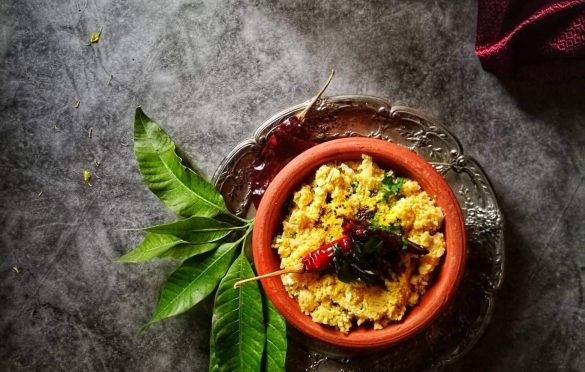
This is also the season when you start seeing Green mangoes on the tree in India. So naturally traditionally two dishes using the green mango are always made for this haldi kunku, Aam Panhe, a drink made with cooked green mango & jaggery and the second is this , Kairichi Daal.

I love both of these things very much. Today when I picked up the green mango to make this, it turned out not very sour but the kiwis I picked up from the farmers market were so sour, so voila, a new dish is born. I added some Kiwi and the results were quite delicious.

It a super easy recipe, hope you guys like it. If you have any such traditions, I would love to know about them. 🙂

I have also written the recipe in Marathi, hope thats useful to some.

Kiwi Green Mango Lentil Salad

This is a typical dish made during the spring while the mangoes are still green and tart. Soaked lentils add a perfect crunch to this salad

Ingredients

साहित्य

  • 2 Cups Chana Daal
  • 1/2 Cup Peeled and grated Green Mango
  • 2 Kiwi Peeled and chopped
  • 3-4 Green Chili paste
  • 1 Tsp Salt
  • 1 Tbsp Sugar
  • 1/3 Cup Freshly grated coconut
  • 1-2 Tbsp Chopped mint leaves
  • 1 Tbsp Chopped cilantro

For tempering

  • 3 Tbsp Oil
  • 1 Tsp Mustard seeds
  • 1 Tsp Cumin seeds
  • 1/4 Tsp Asafetida
  • 3 Dry red chilies
  • 1 Sprig Curry leaves

Instructions

Method

  1. Soak the lentils for 4-5 hours at the least 

  2. Drain and crush them in mortar pestle, make sure you don’t make a fine paste

  3. Mix sugar, salt, coconut, mint, cilantro in the crushed lentils. Once its completely mixed, add the kiwi and green mango. 

  4. Heat oil in a pan. Check if its hot by adding a couple of mustard seeds, if they splutter add the rest of the ingredients and saute for 30 secs. Make sure it does not burn 

  5. Add this tempering to the lentil mixture. The salad is now ready 

  6. Serve at room temperature

Kiwi Green Mango Lentil Salad

This is a typical dish made during the spring while the mangoes are still green and tart. Soaked lentils add a perfect crunch to this salad

Ingredients

साहित्य

  • 2 Cups Chana Daal
  • 1/2 Cup Peeled and grated Green Mango
  • 2 Kiwi Peeled and chopped
  • 3-4 Green Chili paste
  • 1 Tsp Salt
  • 1 Tbsp Sugar
  • 1/3 Cup Freshly grated coconut
  • 1-2 Tbsp Chopped mint leaves
  • 1 Tbsp Chopped cilantro

For tempering

  • 3 Tbsp Oil
  • 1 Tsp Mustard seeds
  • 1 Tsp Cumin seeds
  • 1/4 Tsp Asafetida
  • 3 Dry red chilies
  • 1 Sprig Curry leaves

Instructions

Method

  1. Soak the lentils for 4-5 hours at the least 

  2. Drain and crush them in mortar pestle, make sure you don’t make a fine paste

  3. Mix sugar, salt, coconut, mint, cilantro in the crushed lentils. Once its completely mixed, add the kiwi and green mango. 

  4. Heat oil in a pan. Check if its hot by adding a couple of mustard seeds, if they splutter add the rest of the ingredients and saute for 30 secs. Make sure it does not burn 

  5. Add this tempering to the lentil mixture. The salad is now ready 

  6. Serve at room temperature

Categories
Bihari Drinks & Coolers Fat Free fibre Gluten-free Low GI Protein Vegan Vegetarian Whole Grains

Sattu Ka Sharbat & Banaras

Growing up in Maharashtra, India I had not heard much about this ingredient. My mom used to ask us to eat ‘Saatu’ but it did not quite register as a special thing.

Fast forward many years and I remember my first visit to Varanasi, I fell in love with this place. I know people talk about the dirt and filth but all I could see was the peaceful ghats, a tremendous sense of devotion, and one becoming aware of one’s mortality and of course the food.

Every corner you turned there was some amazing delicacy to be devoured. We feasted on Jalebis, Kachoris, Lassis and so much more. I don’t know if its the water, air or the fact that many of these places have been there for generations, but each thing tasted amazing. I don’t remember having bad food in that town.

A lot of the food eaten was Satvik, which means there was no onion and garlic in the recipe, honestly I did not miss it.

I am a Chai addict and I must say some of the best chai I have had was in Varanasi, I think its the milk thats pure and fresh which makes all the difference. I loved roaming through the lanes and exploring because I feel ‘Banaras happens in the gallis’

I just loved how chilled out people were here, taking there own time to read a news paper, chat with a friend over a plate of kachori or even get a haircut, everything had a sense of calm. I went on a boat ride every morning that I was there, just the sound of water and the oars, some bells in the background and bliss.

Ghats have a lot going on, different ghats decorated in different styles. If you just observe, you get to learn a lot.


I will never get tired of this city, its fascinating on many levels. I feel that even meditating here was very powerful and peaceful.

On our way to the airport we stopped for a cup of chai, I mean everyone knows what kind of chai you get inside the airport 🙂 . On the same stall this man was making litti chokha, and man that was some delicious preparation. He was roasting them on open fire and the best part was that the litti was stuffed with some tasty mixture called Sattu.

That was my introduction to this magical ingredient called ‘Sattu’. This is powder of sorts made with roasted whole chana in most part, however there are some variations that add barley as well as Jowar/sorghum to it. Its commonly seen in the Northern India, mainly Bihar & UP as well as Pakistan and Nepal. Simple sounding however a true superfood, Sattu can be used in multiple applications. Often times savory and sweet drinks are made using Sattu, and in Bihar you would get to taste delicious sattu stuffed litti or even parantha. I must tell you that parantha turns out amazing. I will share the recipe some day soon.

Not only does it taste good and easy to make but its a power house of health benefits. Super high in protein, fibre, gluten-free, vegan and perfect for the summer and it cools down the body.

So when I came back from Varanasi and was talking about it my driver was very happy. He is from Varanasi and an ardent Sattu follower. When he heard that I liked it, he brought two homemade sattu flours for me along with a recipe for the sattu savory drink. I made it and loved it.

I make an effort to make traditional recipes and follow whats good for you in that season, if you like that idea then try out this recipe. Its super easy

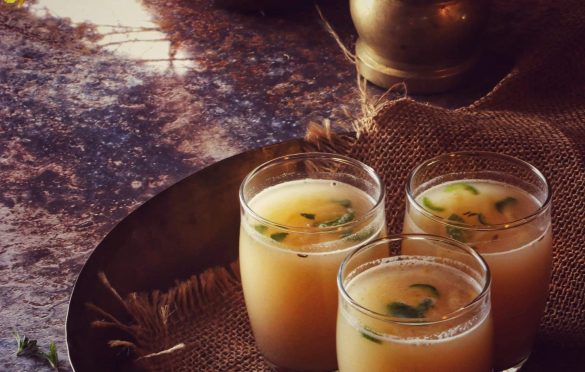
Sattu ka namkeen sharbat

Cooling  

Naturally gluten- free & vegan 

Low GI

Ingredients

  • 2 cups cold water
  • 2 tablespoon gram sattu
  • 1 1/2 tsp lemon juice like to taste
  • 1/4 T Spoon Sendha Namak
  • 1/2 tsp spoonful of cumin seeds
  • 1 tsp finely chopped mint
  • 1 tsp finely chopped cilantro
  • 3 tbsp peeled and grated Green Mango optional
  • 1/4 Tsp finely chopped green chillies optional
  • 1/4 tsp salt

Instructions

  1. Mix the sattu with a little bit of water, enure there are no lumps left

  2. Mix the rest of the ingredients along with the remaining water & stir

  3. Serve chilled 

Recipe Notes

You can also make a sweet version, mix a little bit of honey or Gud with water and sattu powder

Categories
dessert Indian Maharashtrian Main Dish Rice Vegetarian

Narali Bhaat

Narali Bhaat

If you notice coconut is used extensively in Maharashtrian cooking, especially in the costal  cooking. Same three ingredients, fresh coconut, Jaggery and rice are used to create a variety of desserts.

Modak

You take the rice flour, fresh coconut and jaggery, with a little bit of steam you turn it into this delicious dumpling, Modak. Modak are made specially for Ganesh festival as those are Bappa’s favorite.

Patole

You take the rice flour, make pancake with it. Stuff it with a earthy mixture of fresh Coconut, jaggery and some aromatic spices like cardamom and poppy seeds, That turns into patole. The same are also found in Kerala

Sandane

Soak the rice, grind it coarsely, makes some jaggery and coconut, steamed the whole make sure to make something like a pudding which can be enjoyed with sweetened coconut milk, it’s called Sandane. Sometime you can also add jackfruit pulp, I love that variation a lot

Ghavan Ghatale

A pancake is made with rice flour and eaten with coconut milk sweetened with jaggery

As you can see that traditional recipes use ingredients that are local, which is why I love cooking these recipes and sharing with everyone.

Today’s recipe is no different, it uses these very simple basic ingredients and turns into this comforting delicious dessert.

Rakshabandhan/ Narali Poornima

The fisherman community does not fish during the monsoon months. They treat the sea as their God and let it rest for those four months. Its on this day that they restart the fishing. They sing songs, dress up and offer coconut as an offering to the sea.

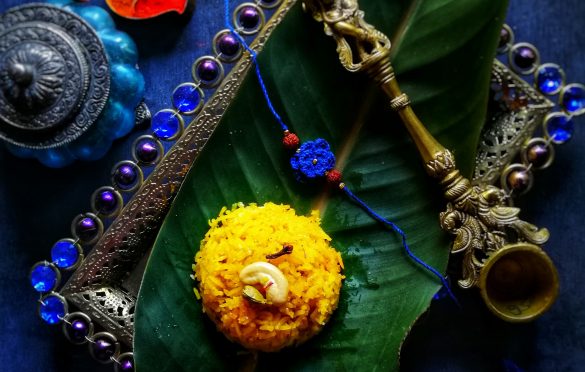
On this full moon the fisherman community celebrates with praying to the ocean God and offer him a special treat of this rice. Since the rice is heavily flavored with coconut, it’s called Narali bhat and the full moon is called Narali(naral=coconut) Poornima( poornima=full moon 🌝)

Narali Purnima

This is also the day when most of the Indians celebrate ‘Rakhi Poornima’. The word is based on the word, ‘ Raksha’, which means protection. It is believed that the sister ties this colorful thread, Rakhi on her brothers wrist as a thank you for protecting her. The brother makes a promise to take care of her.

Now a days it’s a celebration of sibling’s love and I absolutely adore that. We are three sisters and the youngest brother, and on this day we remind each other of the love we share and promise to be there for each other.

This year we could not be together for celebrating this festival but I at least tried to celebrate with this special bhaat and shared it virtually with them.

Here is the recipe!

Narali Bhaat

A sweet rice dish with coconut and jaggery, flavored with saffron.
Course Dessert, Main Course
Cuisine Indian, Maharashtrian
Keyword easy to make, gluten-free, vegetarian
Author Anagha

Ingredients

Ingredients

  • 1 cup Basmati Rice
  • 2 cups water
  • 1 pinch of salt
  • 4 Cloves
  • 4 Green Cardamom
  • 4 tbsp Clarified Butter/ Ghee
  • 8-10 Cashew split in halves
  • 1 Tbsp Saffron dissolved in 1 tbsp milk
  • 1 cup Freshly grated coconut
  • 3/4- 1 cup Jaggery

Instructions

  1. Soak the rice for 15-20 mins in cold water. Drain and set aside

  2. Heat 2 tbsp ghee in a heavy bottom pan

  3. Fry the cashews and set aside

  4. Add cloves and cardamom and saute for a min

  5. Add drained rice and saute for another min

  6. Add the boiling water to the rice and stir

  7. Add a pinch of salt, bring it to a boil and cover

  8. Let the rice cook till all the water is absorbed.

  9. Once the rice is cooked, spread it on a plate to cool

  10. Mix coconut and jaggery and cook till the jaggery melts and the mixture comes together

  11. Add the cooked rice and mix with very gently

  12. Cover and let it steam for 5-7 mins

  13. Add the remaining ghee and saffron milk and mix well

  14. Add the fried cashews and serve

Categories
dessert Indian Maharashtrian

Pakatali Poori- Saffron- Lemon flavored bread

I not only love to cook and learn new foods, but also love to learn about the ‘Old foods’. I feel in this era of instant and quick foods, we are missing out on some incredible dishes. We dont know how to use certain ingredients and soon those will become extinct. A lot of the dishes our gradmoms made, have never been a part of the food at our table.

I am thankful to books like Ruchira, we have access to at least a few of the Maharashtrian recipes. Its a book that is given as a wedding gift to every new bride in Maharashtra. I have used it extensively as when I got married, I did not know how to cook. I would call my mom but 1 minute call to India costed $1.90 and there was no internet. So getting cookbooks, going to the library and watching cooking shows was how I learnt my cooking.

Going back to the ‘lost recipe’, this recipe is almost on the verge of it. Today is Vasant Panchami, a day that marks the arrival of the ‘Vansant ( spring)’ season and you also worship Goddess Saraswati on this day.

img_5417

 This is a very special recipe because of Baba’s aunt used to make it, and she made it really well. I thought, why not make something I have never made before,after all Saraswati is a goddess of Knowledge, and what better tribute than a new( old) recipe. 

I have made  a couple of small modifications o the original recipe, I mixed half Rava and half all purpose flour, also rolled the poori like you roll the Chirota or Khaja ( another Maharashtrian delicacy)

It is a very easy recipe and you will find most of the needed ingredients at home. 

Pakatali Poori

pakatali-poori-main

Ingredients 

Poori

  • 1/2 cup fine rave
  • 1/2 cup All purpose flour
  • 3 tbsp Ghee ( clarified butter) melted and slightly warm
  • 3 tbsp sour full fat yogurt 
  • Pinch of salt

Syrup

  • 1 cup fine sugar
  • 1/2 cup water
  • 1/8 tsp cardamom powder
  • Saffron strands
  • Juice of 1 Meyer Lemon

Method

Poori

  • Mix the rave and APF together with salt
  • Add warm ghee and rub it well in the dry mixture
  • Add dahi to make a stiff dough. If the yogurt/dahi is not sour, you can leave it on the counter so it turns sour. It is crucial since that it what gives these pooris or breads a nice taste
  • Let the dough rest for at least an hour. If you have used only Rava, you would need to let it rest for 2 hours
  • After 2 hours, pound the dough, this is necessary to make it pliable. If you have a stand up mixer, you can use the dough attachment to do the work 

Syrup

  • Mix sugar and water and cook till its ‘2 string stage’ *
  • Heat a pan on very low flame, add the saffron strands and slightly roast them. You are just warming them and not quite roasting. Warming them makes them crumbly and hence they mix well in the syrup
  • Add cardamom powder, saffron and the juice of 1/2 lemon
  • Keep the syrup on a low flame, but keep it warm. This ensures that the syrup soaks in the Pooris. If the syrup is not warm enough, it will only create a coat on the outside

Making the Pooris

  • Heat oil in a deep pan
  • You can roll the Pooris like a regular flat bread, or
  • Roll out a big poori. Make a roll and cut into 4-5 pieces
  • Flatten those pieces again to make a poori
  • Fry the poori till golden brown
  • Drain and immediately add them to the warm syrup. 
  • Ater 10-15 mins, take them out and arrange on a plate
  • If you like, you can user slivered almonds or pistachios as well

img_5407

en_USEnglish