Categories
bread Indian Maharashtrian Snack Vegetarian

Mumbai Pav

The first thing I do when I land in Mumbai the first thing I do is have a cup of cutting chai, you know I am super crazy about Chai, I probably have 4-5 cups everyday.

The second thing I do is have Vada Pav. I have fond memories of traveling in the train and eating Vada Pav, served with spicy sautéd green chili and garlic chutney. I have a recipe for Vada Pav

Vada Pav is a popular street food in Mumbai, in fact Mumbai has amazing street food in general. Pav Bhaji, Pani Poori, Vada Pav, Tawa pulav, Ragda Pattice, Kutchi Dabeli, the list just goes on and on. When you talk about food like Kutchi Dabeli, Vada Pav, Pav Bhaji, you quickly realize that Paav/Bread is a critical element for these.

Kutchi Dabeli

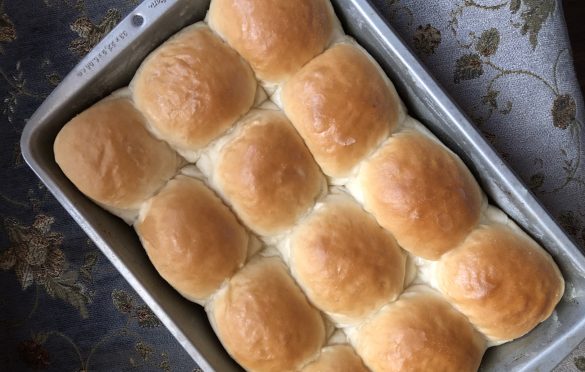
In Mumbai this bread is called Laadi Paav. Laadi is the tiled floor, when you see the sheets of this bread, you understand why it gets that name.

The bread came to India with the Portuguese, as I was reading more about this it seems like this Laadi Paav is similar to the Portuguese bread, Papo Secos. When I visited my sister in Miami, I tasted a Cuban bread, Pan De Agua and it was very smilar to the Ladi Paav.

My family is crazy about Pav Bhaji and Kutchi Dabeli, I end up making these at least twice a month if not more. In California I tried using Burger buns, dinner rolls, Kaiser rolls, but nothing tasted like the Paav I was used to eating growing up in India. So I talked to many people, read books, watched videos and came up with a recipe that works perfect for my family, I feel it comes closest to the Paav I have eaten.

Paav is made with simple ingredients like Yeast, Flour, Sugar and water. When I talked to some of the bakeries, I was told that its a poor man’s food so no fancy ingredients like Milk Powder or milk are used.

The trick is in the process and I feel that these three things are important:

  • High hydration dough- The dough should be quite lose, this allows the yeast to create large air pocket while baking.
  • Gluten formation- The dough needs to be kneaded so that strong gluten forms which can stand up to those air pockets while baking.
  • High temperature baking- Baking at high temperature for a shorter time is critical to get that crust.

I feel bread making is just as much an art as science, do even though I have given the exact recipe, I have also made a video which shows all the steps in detail.

Once you master this, you will be able to make them at home with the ingredients of your choice, I use unbleached organic flour and organic butter.

Ladi Pav

Pav Bhaji, Batata vada or kutchi dabeli, these all dishes are incomplete without a perfect Paav. This easy to make recipe will remind you of the Ladi pav from Mumbai.

Course bread, Snack
Cuisine Indian, Maharashtrian
Keyword Ladi Pav, Paav, pav, pavbhaji, vadapav
Prep Time 20 minutes
Cook Time 10 minutes
2 45 minutes
Total Time 30 minutes
Servings 6

Ingredients

  • 190 gms Water About 3/4 and a little more
  • 7 Gms Instant Yeast About 2 1/4 Tsp or 1 packet
  • 2 Tbsp Sugar
  • 250 gms All Purpose Flour
  • 3 Tbsp Unsalted Butter melted
  • 1 Tsp Salt

Instructions

  1. Heat the water to 100F. I use a thermometer to check because this is critical for the yeast to rise.

  2. Add sugar and yeast and set aside for 5 mins

  3. Add melted butter to the flour and mix. Add salt and mix it a little more. 

  4. By now the Yeast mixture should be frothy, this shows that the yeast is active

  5. Add the yeast mixture to the flour and mix until it comes together. 

  6. Now take the mixture on the counter and knead for good 10 mins. Don’t be alarmed if the mixture is wet, as you knead you will see that it comes together. 

    Dont be tempted to add more flour. Lose dough is key to a fluffy and soft bread

  7. Put the dough in a greased bowl, cover and let it rise for about 50- 60 mins. The dough should double, so if the temperature is cold, let it rest for 60 mins

  8. After 60 min, take the dough on the counter, deflate and knead for 3-4 mins

  9. Divide in 12 equal pieces. I use a scale. Equal balls ensure that the bread is of same size and also cooks uniformly

  10. Grease and dust with flour a 9×13 pan. I use the Wilton Brownie pan. 

  11. Roll the dough pieces in a tight ball and arrange in the pan. Make sure when you roll, you are making the surface taught, and also the seam side should be down. This ensure that when the dough rises, all air gets nicely trapped, making for a spongy bread

  12. Let the balls rest anywhere from 60-75 min. They should be visibly plump

  13. Heat the oven to 450 F

  14. Bake the bread for 8-10 mins. After 10 mins even if the crust does not look super dark brown, dont be tempted to bake longer

  15. Take the pan out and immediately brush with a little butter

  16. Cool on the baking rack. 

  17. Enjoy the Paav is ready

Recipe Video

Categories
bread Fusion Jewish Maharashtrian

Til-Gul Babka Jewish Indian bread

Nothing is more appetizing than the smell of freshly made bread. Be it the fresh roti that is made right on the stove top or a loaf of bread baked in the oven.. it calls everyone to the kitchen and around the dining table. I am not much of a baker, I do bake cakes occasionally but it does not come to me naturally. I feel cakes are way easier than the breads, when you start baking breads, you are going closer to the science than art.

After MasterChef, one of the goals has been to bake more often and since my family is not too much into the cakes, and I like to challenge myself, I am planning to bake more breads and try new techniques.

January is one of my favorite months. This is the month of resolutions, new beginnings and many more things. One of the things is Hurda, its my most favorite thing on this face earth, and this is the time we celebrate Sankranti. This is the only festival in Maharashtra that is based on a Solar/Gregorian calendar, rest of them are all lunar calendar based. Sankranti is celebrated on the 14th of Jan, and other parts of India celebrate this festival with different names, Pongal in southern India, Bihu in Eastern India, Uttarayan in Western India and Lohri in Northern India.  The common theme is great food and happiness and most of the  sweets  are made from Sesame seeds and Jaggery. Both these foods create ‘heat’ in the body and hence eaten during this winter season.

Going back to my baking breads, as you know, I love combining flavors. I had seen this sesame bread recipe on pintrest and that is also my source of inspiration today.So I decided to make this bread which is fit for the Sankrant and something new. Here it comes;

Til Gul Babka


img_8957-2

I know right, it sounds crazy but tasted yummy, if you are into sweet breads, you might want to give it a try. This recipe is quite versatile and can be easily made into a savory bread as well, all you have to change is the filling and you are good to go.

I had read about this technique of ‘Tangzhong‘ and decided to try using it with this bread. I think it definitely helped keep the bread very moist. Tangzhong is a a Japanese technique, it makes for a very sticky dough that is very tricky to handle, but thats what makes for the very soft final product.

Tangzhong is nothing else but a paste made with flour and water, you cook it to almost a roux like consistency. You cool it and mix it in the dough.It sounds so simple and it is, but let me tell you, it created incredibly soft almost pillowy bread.

I think I am so in love this technique that I think I will end up using in everything I bake. 🙂

Back to the recipe

Ingredients

Tangzhong

  • 50 g  Flour
  • 1 cup milk

Bread dough

  • 350 g Bread Flour ( about 3 cups)
  • 1/2 salt
  • 65 g sugar ( about 1/4 cup)
  • 1 egg
  • 1/2 cup warm Milk
  • 2 tsp Yeast
  • About 1 cup Tangzhong
  • 1 egg for egg wash

Filling

  • 1/2 cup Crushed Jaggery ( you can use dark brown sugar if you can not find jaggery)
  • 1/3 cup roasted peanut
  • 4 tbsp roasted sesame seeds
  • 1/4 tsp cardamom powder
  • 2 tbsp molasses
  • 4-5 Tbsp ghee ( or softened unsalted butter)

Method

Making Tangzhong

  • Mix in the water and flour to form a good slurry
  • Cook it on low flame till it thickens. It should be a little less thick that a mashed potatoes. One way to check is if you stop stirring, does the mixture stays in circles and you can see the bottom of the pan
  • Take it off the heat, cover with a plastic wrap, making sure it touches the surface of the paste. This will ensure that no crust forms
  • Cool the Tangzhong to use later

Making the filling

  • Grind all the ingredients except the ghee and molasses
  • Mix the powder in ghee and molasses to make a paste

Making the dough

  • Warm up the milk and add the yeast. Leave it aside for 10-15 mins for it to foam up
  • Until then mix, Flour, Salt, sugar, sesame seeds
  • Add an egg and mix
  • Now add the yeast and milk mixture and mix for 30 secs
  • Add the tangzhong that is cooled
  • Now knead the dough in the stand mixer for 10-15 mins
  • Keep adding softened butter while the mixer is running
  • The dough will be a very wet dough, don’t worry. If the dough sticks to the bottom of the bowl, don’t worry
  • Take a greased bowl and transfer the dough.Let the dough roof for at least 2 hours.
  • I like to proof my dough in the fridge, so I can use it when I am ready
  • The dough should double in size

Assembling it together

  • Punch and deflate the dough
  • Roll it into a reactangle
  • Spread the filling evenly

Shaping the bread

  • Take the rolled log and cut it along the length with a sharp knife
  • Twist the two parts together to form a braid keeping the cut side up
  • Take a bread loaf pan that is greased and lined with a parchment paper
  • Add the dough in it and let it rest for at least 60 mins

Baking

  • Heat the oven at 350 F
  • Brush the dough with egg wash and bake for 25-30 mins in a 350F

Note:

  1. This dough was a little more than a standard bread loaf can handle, so I removed about 1/3 cup dough before shaping it
  2. If you can not find molasses, you can substitute with honey

img_7265


en_USEnglish